Kerri Chandler — Learning to Listen
For a long time, vocals were almost a red flag for me in House music. During the first ten or fifteen years of collecting House records, hearing vocals while listening to a record often meant one thing: next one. That made Kerri Chandler a difficult artist for me. Many of his early productions contained exactly what I was trying to avoid. I would pick up one of his records, start listening, hear the vocals — and put it aside again. For quite a while, that was more or less the end of the story.
Track 1
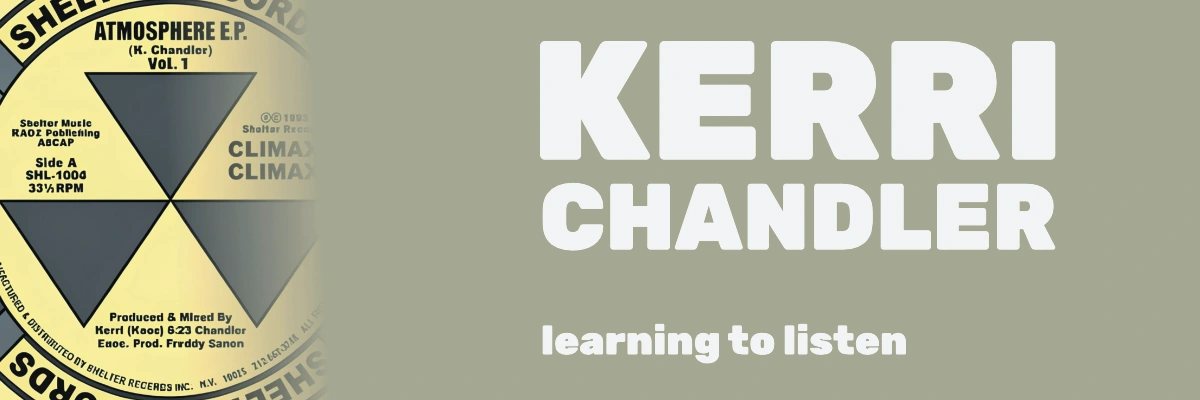
There was one exception. Track 1 from Kerri Chandler’s Atmosphere EP on Shelter Records, released in 1993. I cannot remember exactly when I first heard it. I may even have heard the track many times before I realised it was Kerri Chandler. I think it was around 1998 or 1999 when I consciously connected the two. And this record had something the others didn’t.
The bassline arrives very early in the track, and on a good sound system it does more than just sound good. You can feel it. It pushes. Hard. There are also horn sounds in the track, and I have always had a weakness for that kind of sound. Together with the bassline and the other elements, it creates exactly the kind of atmosphere I love in House music. The title of the EP could hardly be more appropriate.
But Track 1 did not suddenly turn me into someone who loved everything Kerri Chandler produced. It did something more important. It made me change the way I listened to his records.
Listen Properly
I wasn’t annoyed with myself for having overlooked something. There was no great revelation of: How could I have missed all this? It was much simpler than that. I basically gave myself an instruction:
Next time you find a Kerri Chandler record, listen properly.
Don’t stop at the first vocal. Don’t assume you already know what the rest of the record will sound like. Listen to everything. And that is what I started doing. The timing helped. The internet was beginning to change the way we could search for music. Suddenly there were online record shops where you could listen to short clips of new releases without having the actual record in front of you. Calling it a comfortable listening experience would be generous.
ISDN connection. RealPlayer. Terrible audio quality. Welcome to the future.
But it was enough. Instead of judging a Kerri Chandler record after the first track that didn’t appeal to me, I could jump through everything. And slowly, I began finding more and more tracks that I liked. Not everything. Not even close. But enough to keep digging.
Going Sideways
That process became much bigger than Kerri Chandler. You find a record you like. You look at the label. On that label you discover another artist. That artist has released something on another label, so you look through that catalogue. And suddenly you are somewhere completely different from where you started.
This kind of sideways searching taught me a lot about House music. It still shapes the way I discover music today. One record does not simply lead to another record. It can lead to an artist, a label, a city, a particular sound or an entire corner of House music you had never explored before. Kerri Chandler became one of those starting points for me. Not because I loved everything he made. Quite the opposite. I had to search.
Coming Back to Madhouse
Madhouse Records followed a similar path for me.
I had known about the label for a long time and knew that it was Kerri Chandler’s label. But because I had never connected easily with large parts of his earlier sound, I did not pay particularly close attention to Madhouse either. That changed gradually. Releases from around 2010 onwards began catching my attention again, and I found more records that worked for me.
Then, from around 2018, a lot of digital releases appeared on Madhouse that I really enjoyed. Many of them were not produced by Kerri himself. They were modern, deep House tracks by other artists, but to my ears they still fitted naturally into the musical world surrounding his label. Once again, Kerri Chandler had led me somewhere without necessarily being the person producing the record I ended up playing.
The Vocal Problem
And then there is the slightly inconvenient ending to all of this. I still don’t generally go looking for vocal House. My taste hasn’t changed that much. But I am no longer as quick to dismiss a record simply because somebody starts singing. And one of my favourite records involving Kerri Chandler today?
The Songstress – See Line Woman on Ibadan.
A record with vocals. Of course. After spending years putting Kerri Chandler records aside as soon as I heard a voice, there is something wonderfully appropriate about that. Maybe my taste changed a little. Maybe I simply learned to listen beyond the first thing I thought I didn’t like. Probably both.
Kerri Chandler was never an artist where I could pick up every record without listening and assume I would love it. He was almost the opposite. But perhaps that is exactly why he became important to me. Some artists give you exactly what you are looking for.
Others make you search a little harder.
And sometimes, the searching is the part that stays with you.